Type: Concept Project | Self-directed brief, full system
Role: Brand identity, user research, mobile app design, environmental & experiential graphics
Disciplines: Brand identity systems · User research & persona development · Mobile app UI · Large-format & environmental graphics · Signage & wayfinding · Credentials & merchandise




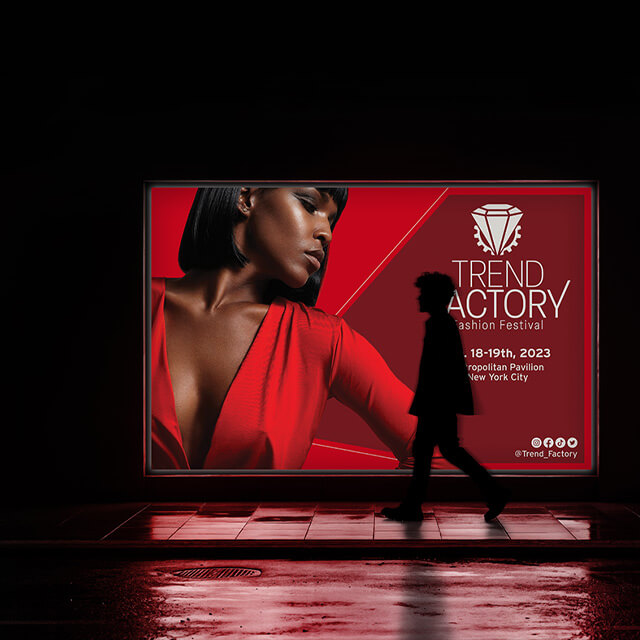

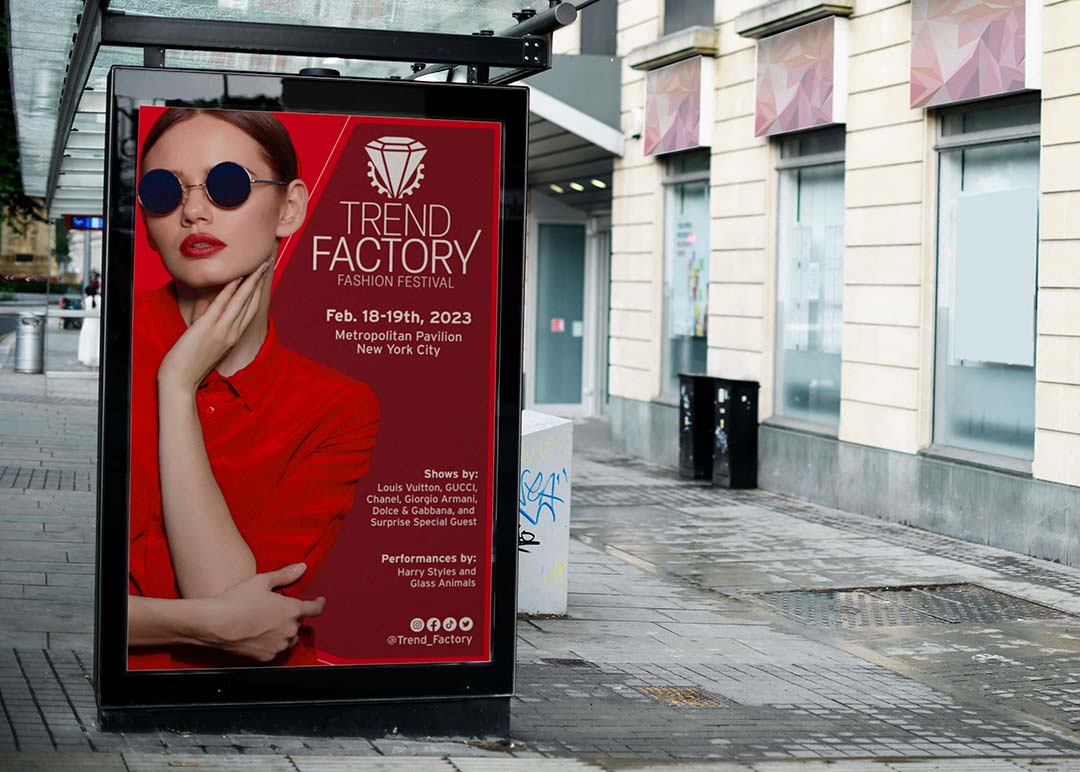

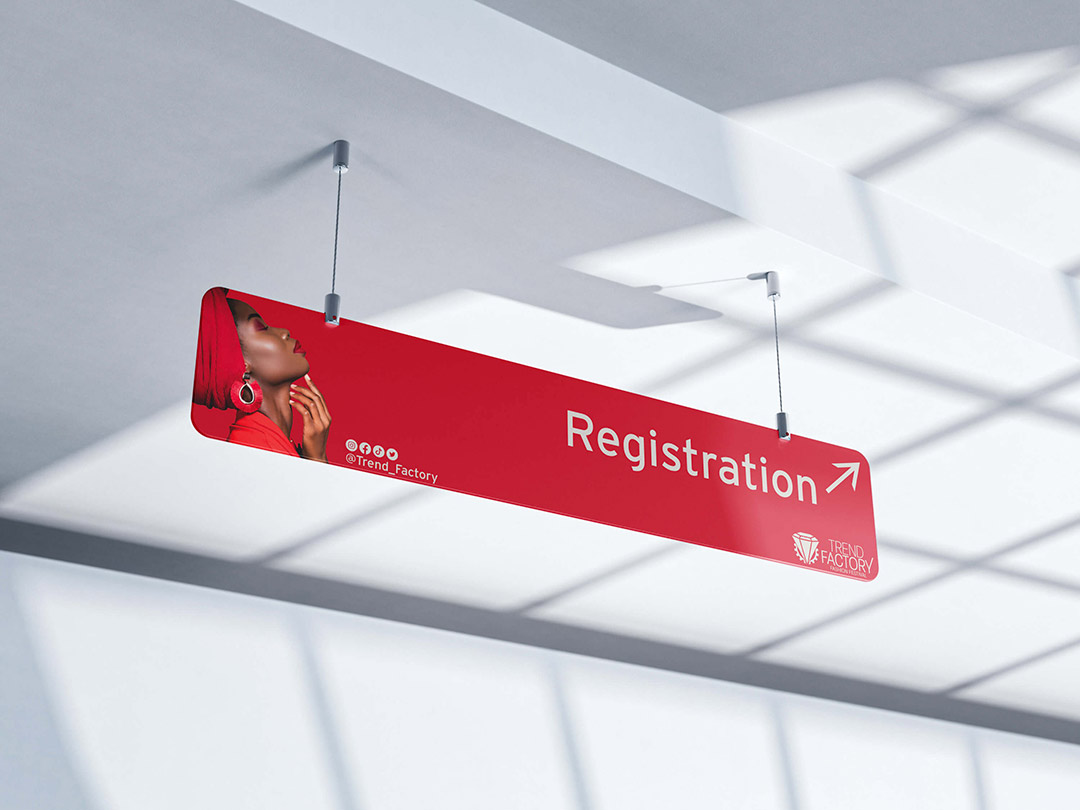


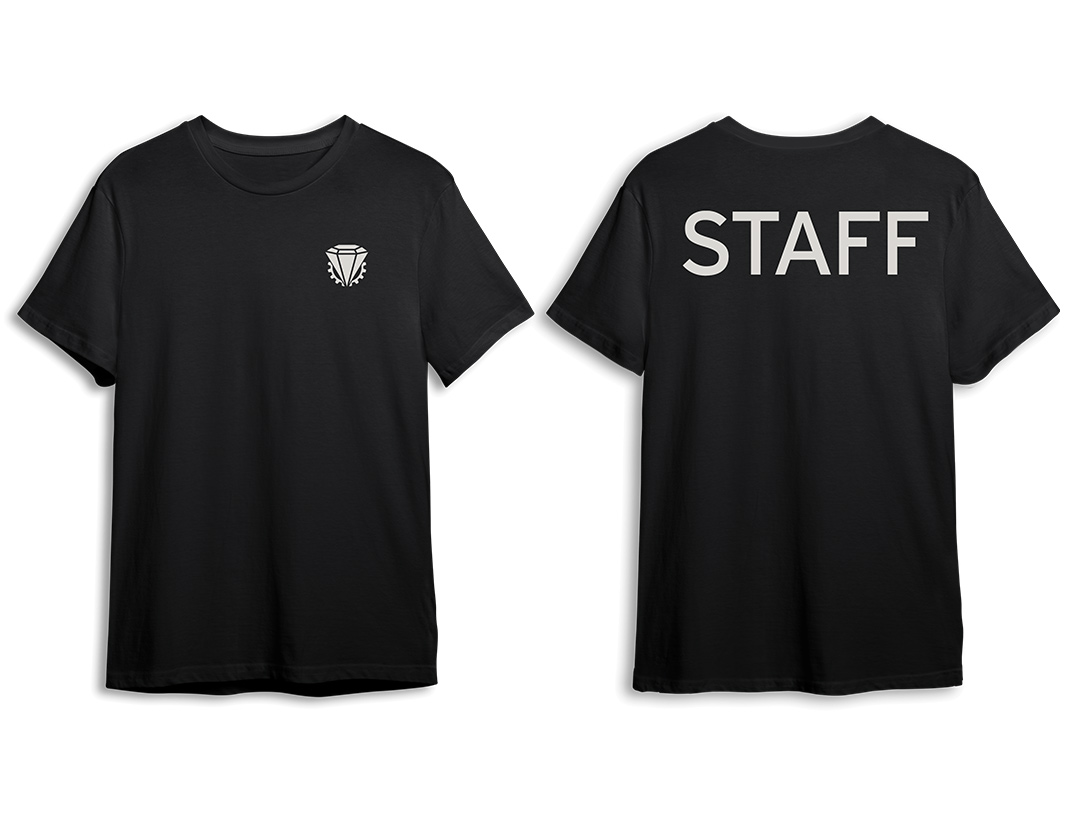
Trend Factory is a concept project in which I created a complete brand identity for a fictional avant-garde fashion festival, carried from a research-driven foundation into the street, the venue, the hand, and the phone. The goal was to design a brand bold enough to hold its own on a New York skyline, precise enough to guide a guest through a venue, and coherent whether it appears two inches tall on a phone or two stories tall on a building.
The brief: create a brand that feels exclusive and high-fashion without feeling cold, confident enough for a billboard, clear enough for a wayfinding sign, and consistent across every touchpoint a guest might encounter, from the first ad they see on the street to the credential around their neck on event day.
Before finalizing visual choices, I created a persona to define the brand voice and digital priorities: Jenna Price, "The Actress & Influencer." At 41, she’s fashion-forward, married, with around 200K followers, and her career depends on staying ahead in fashion and curating an appealing online life.
Her goals: discover new trends early, grow her following, and find outfits that match her mood. Her pain points include the pressure to produce relevant content, the competitiveness of influencer work, and a desire for an all-in-one platform. This informed design decisions: an effortless, exclusive event experience, an app revealing surprise guest designers, and photography-friendly moments.
Jenna's style references Chanel, Dolce & Gabbana, Gucci, Valentino, and Louis Vuitton, guiding the brand’s confident, luxe visual tone, avoiding a generic festival look. This approach balanced restraint and boldness, important to a status-conscious audience that notices logo overuse.
The research was compiled into a persona document with qualitative and quantitative data, goals, motivations, pain points, and behavioral insights, used throughout the design process.
The name combines two opposing ideas: the polished elegance of trend and the industrial machinery of a factory, both reflected in the mark. A faceted gem inside an industrial gear symbolizes luxury built, not just born. The gem features clean, angular facets set within a deep crimson gear that suggests structure and shadow beneath its brighter red. The wordmark emphasizes this tension: "TREND" is in a thin, refined font, while "FACTORY" appears below in a bold, industrial weight, making the contrast clear. "FASHION FESTIVAL" is written in light caps beneath, framing the tension in a calm sub-line.
Color-wise, two reds are used: a bright scarlet (#D62D29) for the gem and action surfaces, and a deep crimson (#74181F) for the gear, "TREND," and more sustained surfaces. This cohesive color system maintains a unified, confident look across all materials.
The identity was built with three lockup variations from the outset, so it could scale to whatever a given surface demanded:
- The full stacked lockup — gem-and-gear symbol above the two-weight "TREND FACTORY" wordmark and "FASHION FESTIVAL" sub-line used as the primary mark on posters, the app login screen, and any surface with vertical room to spare.
- The horizontal lockup — symbol to the left, wordmark and sub-line to the right- is used where a wide, shallow format calls for it, such as a website header or letterhead-style application.
- The standalone gem-and-gear symbol — used alone where space is tight: app icon, staff t-shirt chest, VIP pass front. At small sizes, gear teeth and gem facet lines remain legible due to a simple construction that survives size reduction.
The app had to build pre-event excitement and serve as the main tool during two days of programming. It was designed as an interactive flow, incorporating the two-red system, type pairing, and gem-and-gear mark into a functional interface.
- Login — the stacked lockup appears above email/password fields, with a ‘Forgot Password?’ link, Login and Sign Up buttons, and a ‘Need a ticket? Buy now’ link for attendees.
- Home / Browse — a persistent search bar sits above the lockup, followed by a horizontal ‘Designers’ row (Gucci, Dolce & Gabbana, etc.) and a ‘Performances’ section below, providing Jenna with a quick, visual browsing experience her persona’s “easy one-stop shop” needs.
- Schedule — a tabbed view toggles between Feb. 18th and 19th, displaying shows by time, designer, and thumbnail, with a favorite-star toggle for attendees to create a personal must-see list across the two-day program.
- Show Detail — tapping into a show provides Location, Room, When, Duration, and a full Description, offering attendees essential information to navigate the event, similar to digital wayfinding.
- Tickets — a General Admission ticket includes the attendee’s name, a unique Ticket ID, a scannable QR code, entry details (doors, first show time), and options for upgrades and additional purchases needed for the event day.
A bottom tab bar (Home, Schedule, Favorites, Tickets, Profile) keeps core functions accessible, making the interface feel like a unified tool rather than disconnected screens.
This section discusses how the brand extends beyond the screen into physical spaces at various scales and viewing distances:
- Street-level backlit billboard — a large illuminated lightbox at street level, visible at night with a red model against a dark crimson background, standing out on wet pavement and silhouettes passing by. It required instant recognition in low light, challenging the high-contrast lockup more than daylight posters.
- Street pole banner — a vertical banner on a building facade displaying the full lockup, event details, and social handle with campaign photos, transforming a typical street into part of the campaign.
- Transit-shelter poster — at eye level, featuring the complete lineup of luxury brands and performances, packed with information yet maintaining clarity within the two-red system.
- "Become the Trend Setter" building wrap — the largest application, with the wordmark's contrast robust enough to scale from app icon to building, demonstrating the design’s scalability.
Designing these environments requires considering viewing distance, format, and lighting conditions, for example, what’s legible from a moving car versus a bus stop or a dim street at night, key aspects of environmental and experiential design.
Inside the venue, the brand becomes infrastructure; it has to direct, not just decorate.
- Hanging directional sign — a ceiling-mounted “Registration →” sign suspended from a cable system in a sunlit interior, displaying the brand’s colors, type, and a campaign photo, serving a functional purpose: guiding arriving guests efficiently without them stopping to search.
- Interior schedule board — a wall-mounted schedule in circulation space lists Feb. 18th time blocks with designers, shows, and rooms: Giorgio Armani in The Gallery, Dolce & Gabbana in The Level, Moschino in The Suite, Prada in The Gallery, and Harry Styles in the Full Pavilion, allowing attendees to see the day’s layout at a glance without opening the app.
Together, these form a wayfinding family: directional signage that moves people and informational signage that orients them, all drawn from a single consistent system.
The system includes wearables and carryables:
- VIP pass & lanyard — two-sided credential with a light-front displaying "VIP pass" in two-weight type and a full-color gem-and-gear symbol, and a deep-crimson back showing the attendee's name, QR code, ticket ID, and event dates. Jenna Price's pass matches her digital ticket exactly, linking physical and digital systems.
- Staff apparel — a black tee with a small gem-and-gear symbol on the chest and a bold "STAFF" across the back, designed for quick recognition in crowded areas.
Trend Factory is a project where I grounded every visual decision in a person's goals, starting from research and a persona built around real motivations and pain points. I created a single mark and system that scaled across a mobile app, advertising, wayfinding, and credentials from a phone icon to a building wrap, in lighting conditions from daylight to nighttime.
It shows my view of brand as a coherent system that must perform everywhere a person encounters it, tailored to their goals and consistent enough to carry from a phone screen to a lanyard.
As a concept, it also taught me about viewing distance, format, lighting, placement, and the difference between graphics that decorate and those that guide movement.